Published On: October 27, 2026

Managed cloud services are ongoing IT services that help businesses operate, monitor, secure, and maintain their cloud environments through an external specialist. For Singapore businesses, they can reduce the daily workload on internal IT teams, improve visibility into cloud expenditure, and support reliable access to business applications. Companies should consider managed cloud services when they lack the staff or expertise to manage cloud operations consistently, need stronger security controls, or want clearer accountability for technical support. CloudPoints Consulting Pte Ltd helps organisations assess their Microsoft cloud requirements and plan appropriate cloud management services.
Singapore businesses rely on cloud platforms for finance, customer relationship management, collaboration, data storage, and business-critical applications. As cloud usage grows, IT teams must manage security configurations, user access, service availability, backups, and monthly expenditure alongside their other responsibilities.
For small and medium-sized enterprises (SMEs), hiring specialists for every cloud technology can be expensive. Larger organisations may have internal IT departments but still require additional expertise for Azure infrastructure, Microsoft 365 security, cloud cost management, or after-hours incident response.
Managed cloud services Singapore providers can help address these requirements through agreed operational responsibilities and defined support arrangements.
Common business drivers include:
The appropriate service scope depends on the company’s industry, cloud architecture, internal expertise, and operational priorities.
A managed cloud service provider takes responsibility for specified cloud operations under a service agreement. The provider may manage infrastructure, monitor system health, investigate incidents, review security settings, and help control cloud spending.
Typical responsibilities include the following.
Cloud infrastructure management
This covers the administration of cloud resources such as virtual machines, storage, networks, and supporting services. A provider may review resource utilisation, coordinate maintenance, manage approved configuration changes, and investigate performance problems.
For a Singapore company hosting its applications on Microsoft Azure, these activities can help maintain reliable systems for employees, customers, and business partners.
Cloud monitoring and maintenance
Cloud monitoring tracks agreed indicators such as resource usage, availability, performance, and selected security events. Proactive cloud monitoring uses alerts and established thresholds to identify unusual behaviour or developing problems.
For example, a provider may investigate repeated application failures, storage capacity warnings, or unexpected increases in virtual machine consumption before these issues cause wider disruption.
Monitoring coverage and response times depend on the contract. A business should not assume that a monthly management package automatically includes round-the-clock monitoring.
Security and access management
Providers may help configure multifactor authentication, role-based access controls, security policies, logging, and patch management. They can also support vulnerability remediation and incident investigation where included in the agreement.
Singapore businesses handling customer, employee, or supplier information should establish clear responsibilities for protecting personal data. The Personal Data Protection Act (PDPA) sets requirements for organisations handling personal data in Singapore, including protection and retention obligations where applicable.
Outsourcing cloud operations does not automatically remove an organisation’s responsibilities under the PDPA. Businesses should also assess applicable sector-specific requirements and contractual obligations.
Backup and disaster recovery
A provider can monitor backup jobs, maintain recovery documentation, and conduct restoration tests according to agreed procedures.
Companies should define recovery time objectives (RTOs), which describe how quickly a service needs to be restored, and recovery point objectives (RPOs), which establish how much data loss is acceptable in a disruption.
These targets are particularly relevant to businesses that depend on cloud-hosted financial records, customer databases, or operational systems.
Cloud cost management
Providers can review cloud bills, identify unused resources, recommend suitable resource sizes, and configure spending alerts.
For Singapore organisations, the review should consider the actual billing currency, applicable taxes, cloud subscription terms, data transfer charges, and the location of deployed resources. Cloud pricing can differ by service, region, usage, and contract, so cost comparisons should use the organisation’s actual requirements.
Managed cloud services follow an agreed operating model. The provider and business establish which systems are covered, how incidents are handled, and how performance will be measured.
A typical engagement involves five stages.
For Singapore businesses, the arrangement should also specify who is responsible for communicating incidents to management, coordinating with cloud vendors, and supporting internal or external compliance reviews.
Managed cloud services are most useful when cloud operations require more time, specialist knowledge, or consistent oversight than the internal team can provide.
1. Your IT team is stretched
An SME may have one or two IT staff members responsible for employee support, laptops, cybersecurity, applications, and cloud platforms. Routine maintenance can take time away from higher-priority projects.
Outsourcing defined cloud operations gives internal staff additional capacity without requiring the business to recruit for every specialist role.
2. Business applications need dependable support
A disruption to email, collaboration, or a customer-facing application can delay work across a Singapore office. Businesses with critical workloads should establish clear incident priorities, escalation paths, and recovery procedures.
A managed provider can help coordinate support according to agreed service commitments, although the underlying cause of recurring failures may still require application or architecture changes.
3. Cloud expenditure is increasing
Cloud bills can rise as businesses add users, retain more data, deploy additional resources, or run services that are no longer required.
A provider can review consumption patterns, recommend rightsizing, and identify idle resources. Management should receive regular reports showing actual spending, major changes, and proposed actions rather than general assurances about cost savings.
4. The business handles sensitive personal information
Companies managing customer records, employee information, or other personal data need appropriate controls over access, retention, and protection.
Managed services can support these controls, but the organisation should assess the provider’s access privileges, data handling practices, subcontractors, incident notification arrangements, and contractual commitments.
Where personal data is transferred outside Singapore, the organisation should assess the applicable PDPA transfer limitation requirements and ensure the necessary protections are in place.
5. The organisation uses Microsoft Azure and Microsoft 365
Businesses using Azure for infrastructure and Microsoft 365 for daily collaboration may need ongoing support across both environments.
Managed Azure services can cover infrastructure monitoring, resource management, backup coordination, and cost reviews. Managed Microsoft 365 services can cover user administration, identity settings, collaboration applications, and agreed security configurations.
A provider should explain how the two environments will be managed together and which responsibilities remain with the internal IT team.
6. The business needs support outside office hours
Companies with regional customers, overseas teams, or systems that operate beyond Singapore business hours may need extended support coverage.
Check the actual service schedule, incident response targets, on-call arrangements, and escalation process. An SLA should distinguish between acknowledging an incident, beginning investigation, and restoring service.
7. The business is preparing for a migration or expansion
Moving workloads to Azure, consolidating Microsoft 365 tenants, opening new offices, or introducing cloud-based applications can increase operational demands.
A managed provider can help establish monitoring, security baselines, documentation, and support procedures. Migration projects and major architectural changes may need separate professional services beyond the recurring management agreement.
The main difference is the scope of responsibility. Traditional IT support often addresses user issues and reported technical problems. Managed cloud services focus on ongoing cloud operations, which may include proactive monitoring, routine maintenance, cost reviews, and security configuration management.
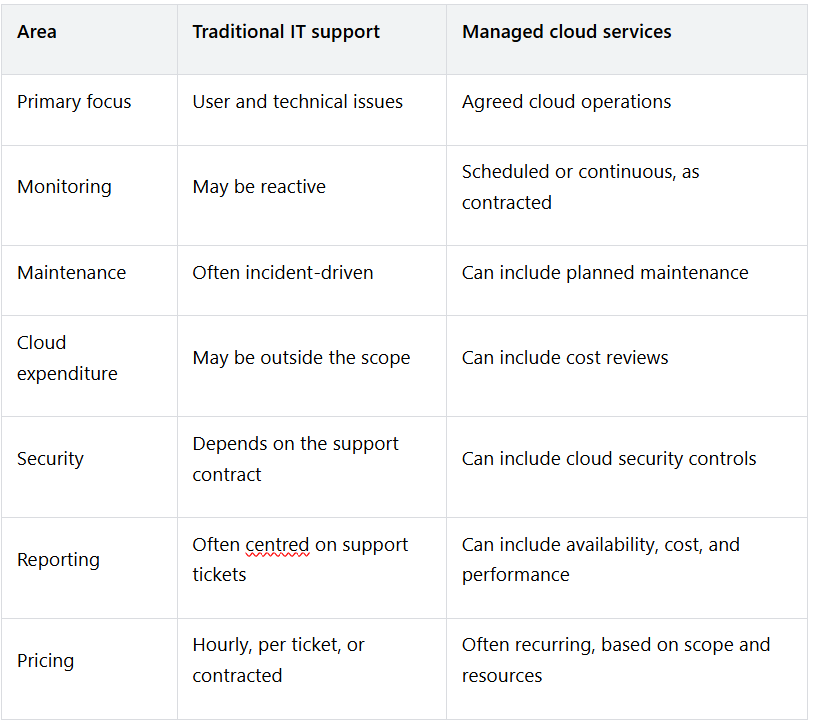
These services can overlap. Singapore businesses should compare the provider’s actual commitments rather than relying on the service name alone.
The right mix depends on the platforms a company uses and the responsibilities it wants to outsource.
Managed Azure services: Suitable for organisations running applications or infrastructure on Azure. Services may include virtual machine management, network monitoring, backup coordination, resource optimisation, and troubleshooting.
Managed Microsoft 365: Useful for businesses that need assistance with user accounts, Exchange Online, Teams, SharePoint, identity settings, and security policies.
Cloud infrastructure management: Covers the maintenance and monitoring of compute, storage, networks, and related cloud resources.
Cloud support Singapore: Provides technical assistance for incidents, access problems, configuration issues, and service disruptions. Businesses should confirm the support hours and escalation commitments.
Security and recovery management: May include access reviews, security alerts, backup checks, recovery testing, and incident procedures. Advanced threat detection or managed security operations may require a separate service.
CloudPoints Consulting Pte Ltd can help businesses evaluate Microsoft cloud requirements and identify the operational support appropriate to their environment.
Pricing depends on the number and complexity of cloud resources, the support schedule, the security requirements, and the work included in the agreement.
Common pricing models include:
The cloud subscription itself may be billed separately from the management fee. Businesses should ask for a breakdown of recurring fees, licences, storage, data transfer, taxes, after-hours support, and additional project work.
The most useful comparison is total cost of ownership. Include provider charges, cloud consumption, internal staff time, security tools, and the cost of maintaining suitable backup and recovery arrangements.
Choose a provider that understands your cloud platforms, can explain its operating procedures, and offers service commitments that match your business requirements.
Evaluate these areas before signing an agreement:
For organisations in regulated sectors, the assessment should also cover applicable regulatory expectations, audit access, third-party risk, and business continuity requirements.
What are managed cloud services used for?
Managed cloud services help businesses operate, monitor, secure, and maintain cloud environments. Common activities include Azure infrastructure management, Microsoft 365 administration, backup monitoring, cost reviews, and technical support.
When should a Singapore SME outsource cloud management?
An SME should consider outsourced IT cloud management when internal staff lack the capacity or specialist skills to maintain cloud systems consistently. Recurring incidents, rising cloud bills, limited monitoring, and unclear security responsibilities are common reasons to assess external support.
Do managed cloud services help with PDPA compliance?
They can support technical and operational controls such as access management, logging, backup procedures, and security monitoring. However, the organisation remains responsible for assessing its legal obligations and ensuring that appropriate contractual and technical safeguards are in place.
Do managed cloud services include 24/7 support?
Not necessarily. Some contracts include round-the-clock monitoring or on-call incident response, while others cover standard business hours. Confirm the operating schedule, response targets, and escalation process before signing.
Are managed cloud services suitable for companies using Microsoft 365 only?
Yes. A business may need help with account administration, identity protection, security settings, service health, and collaboration tools even if it does not operate Azure infrastructure directly.
What should a Singapore business check before hiring a provider?
Review the service scope, pricing, support hours, SLAs, security practices, data handling arrangements, backup responsibilities, documentation, and exit terms. The provider’s responsibilities should align with the organisation’s operational and compliance requirements.
Managed cloud services make sense for Singapore businesses that need reliable cloud operations but do not have the internal capacity to manage every technical responsibility. They can help SMEs control routine IT workloads while giving larger organisations additional specialist support for Azure, Microsoft 365, security, and infrastructure management.
Before committing to a provider, identify the cloud systems that need support, the risks that require attention, and the service commitments your business expects. Compare the full cost, security responsibilities, support coverage, and reporting arrangements. If your organisation needs help reviewing its cloud environment or planning ongoing support, get in touch with us to discuss practical options that suit your business requirements in Singapore.
Australia
P: +61 3 9087 8057 E: info@cloudpoints.com.auSingapore
P: +65 6990 7890 E: info@cloudpoints.com.sg